I was reading
Dave Beckerman's blog (aka,
The Mother of All Photo Blogs) the other day when I noticed the Photography Articles menu item. One of Dave's articles was called
Confessions of a Recovering Camera Addict, sort of his camera history, and it struck a familiar chord with me.
So I thought, why not give my own history of camera addiction?
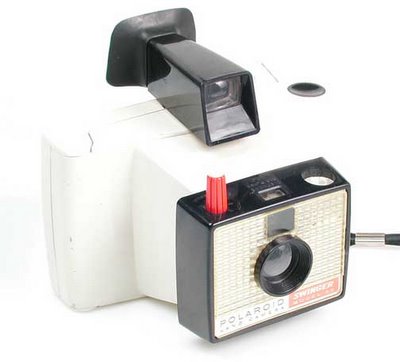
At age 17, it was a swinger that got me started.
Well, to be precise, it was a Swinger - a gray plastic Polaroid Swinger.
The camera was a very thoughtful high school graduation gift from my father's Cousin Ellen and her husband, the late Harold Siegel. I even remember the date - June 12, 1967 - the sixth day of the Six Day War - my parents had invited some family and friends to dinner in honor of my graduation.
Our genuine fear of a week earlier that something terrible was about to happen to Israel had been replaced by the elation of a complete victory for the Jewish State, and that added to the happiness of the evening.
I hadn't expected this wonderful gift, but I was genuinely delighted with the Swinger. The next day, I loaded up with the roll of film the Siegels had included and became a photographer.
The Swinger took a smaller version of what was then the regular roll film pack for Polaroid cameras. When you looked through the finder, part of what you would see was an indicator that said either "No" or "Yes." If you turned the red collar around the tall white shutter button, assuming that there was enough light for a successful photo, the "No" would eventually morph into "Yes," which meant that you had adjusted the exposure properly.
I realize now that it was what's called an extinction photometer - but a pretty effective exposure assistant nonetheless.
Swinger came with a manual, but you really didn't need it - Polaroid had a jingle-equipped commercial that told you all you need to know about how to use the camera - and the aggressive advertising campaign caused that commercial to also permanently embedded the price in my brain... "it's only nineteen dollars and ninety-five!" Hey, $19.95 was nothing to sneeze at to a 17-year-old in 1967.
The great thing about that little Swinger is that it whet my appetite for being able to do more with photography. I asked my friend Roger, who I knew was an avid amateur photographer - he had a Pentax H1a single-lens reflex, which at the time, seemed to me a magical mystery marvel of technology.
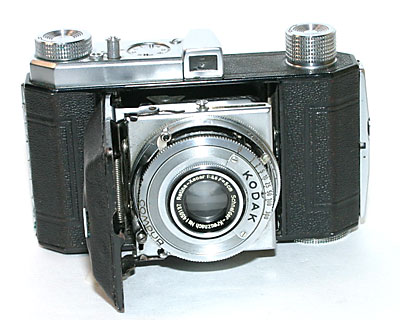
Roger showed me all about shutter speeds, f-stops, and focusing, at which point I dug out of a dusty bureau drawer my Dad's "real" camera, a Kodak Retina 1 (Type 010). Sure enough, there were the shutter speeds, there was the f-stop control, and here was a scale, in meters, for focusing. And by scale, I mean just that - this model of the Retina was a "scale-focuser", which means no rangefinder or other focusing aid - you have to use your calibrated eyeballs. But it had a pretty decent Schneider-Kreuznach 50mm f/3.5 lens, and not having a rangefinder also forced me to learn about
hypefocal distance and use of the camera's
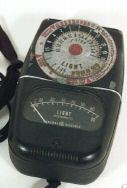
depth-of-field scale. With Roger's tutelage, I soon was taking "real" photos with this "real" camera. Roger even gave me an old GE DW-48 light meter, and so I was in business.
Roger and his dad had built a nice darkroom in their basement, and during that summer, they often invited me over to use it. The first time I saw one of my photos starting to "come up" in the developer tray under the safelight, I was hooked.
That fall, I started college at Stevens Institute of Technology in Hoboken, NJ. I joined the camera club, hung out with other photo enthusiasts, and made good use of the well-equipped darkroom that was available to us. Being a 35-cent, 15-minute ride from Manhattan didn't hurt either, as I was presented with plenty of subject matter.
During the school year, I became good friends with my classmate Rich Schnabolk, who was a more advanced photographer than me. Rich actually had an SLR, albeit a Kowa SE, which I used to rib him about. Nevertheless, I wasn't too proud to use the Kowa and Rich was a good enough sport to lend it to me from time to time. And from humble beginnings... that Kowa made me lust after a "real" camera, that is, an SLR.
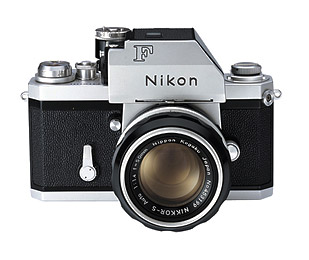
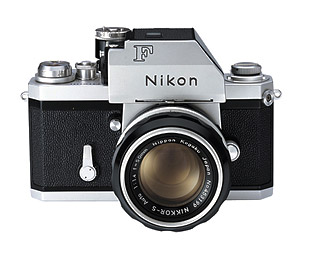
During the summer of 1968, I worked at a photo store nearby. The owner had just bought a new Nikon F Photomic Tn, and offered me his 3-year-old Nikon F Photomic T at a very cheap price. And suddenly, I was a big-time Nikon photographer!
Back at college, I was a yearbook photographer, then photography editor in my junior year. We had bought a Yashica Mat 124 TLR that year, and digging around I found an old Crown Graphic 4x5 press camera that hadn't been used in years. I took both of them home with me during the summer, and I made good use of the TLR as a dog photographer (or, as Mom used to call me,
Photographer to the Dogs.
More history when I get around to it....
 In 1979, I mentioned to my friend Mike Tzougrakis that I wanted to get a small camera for Sandy, then my fiancée. After all, it just wouldn't do for her to keep using a Kodak 110 camera.