
Showing posts with label Architecture. Show all posts
Showing posts with label Architecture. Show all posts
Sunday, July 25, 2010


Wednesday, July 21, 2010
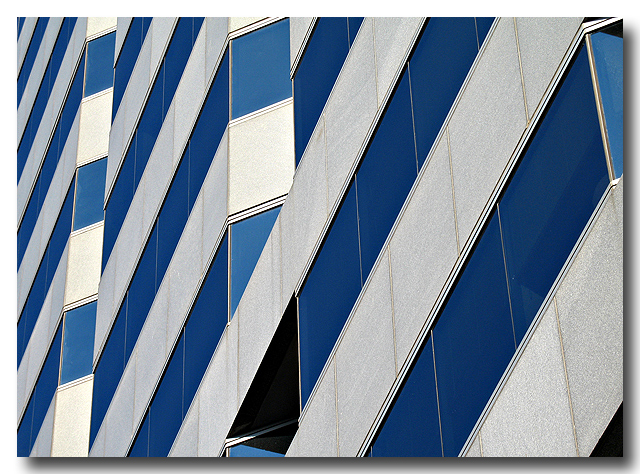
Concrete Swoop
 A portion of the West facade of the Robert C. Weaver Federal Building, home of United States Department of Housing and Urban Development (HUD) in Washington, DC.
Monday, August 10, 2009
St. Michael the Archangel Ukranian Catholic Church
 I've seen the golden onion domes of St. Michael from various places elsewhere in Baltimore, but it was only yesterday, as I drove down Eastern Avenue, that I got to see the church close up. In the bright late-afternoon sun, it just knocked me out.
Thursday, December 4, 2008
Background to the Fore
Here's a trick that I often find useful - find some scene that I like - then using it as a background or backdrop, wait for someone to walk into the scene. You need something photogenic to use for the backdrop... a handsome or unusual building, as in this case, a colorful, graffiti-covered wall, or a path in a park during autumn.
 |  |
 |  |
Saturday, November 1, 2008
Cast Iron Baltimore
 In the second part of the nineteenth century, Baltimore had several foundries producing cast-iron building fronts, making the city a critical supplier of this new construction technique for new buildings around the world. In New York City, you'll find the now-chic Soho area full of cast-iron buildings.
 Baltimore had more than 100 of these cast-iron fronted buiding by 1900, but all but a few were either destroyed the the Great Baltimore Fire of 1904 or torn down during redvelopment. The Wilkins Building in the photo here is one of the few remaining.
Sunday, September 28, 2008
Night Photo - 250 W Pratt
 How many times can I photograph the same building? A lot, if it's a good one, like 250 W Pratt. Since it's caddy-corner to my Light Rail stop, I go past it twice a day every workday.
 Architecturally speaking, crossing the street each morning as I step off the Light Rail is a nice lift, as the Convention Center is on my right hand and 250 W Pratt on my left. In the photo above, you can see the new pedestrian bridge from the Convention Center crossing Howard Street. Unfortunately, this is Baltimore's new Bridge to Architectural Nowhere, as where it connects to is the architecturally-challenged Hilton Baltimore
Tuesday, September 16, 2008
Tech Tuesday: Architectural Restoration
 Why is it that when I take a picture of a tall building, it often looks distorted? Gee, those walls sure looked perpendicular to the ground and parallel to each other when I was standing there! But in the image I come home with, the walls are at all sorts of angles, and the building looks like it's falling over backwards.
Take, for example, the photo here of 160 W. 73rd Street, a lovely Art Deco co-op typical of many of the elegant older apartment buildings on the Upper West Side of Manhattan.
I framed the image carefully in my viewfinder, trying to line up the setback on the right edge so that it looked veritcal. Here's what the image looked like right out of my camear in Photoshop Elements 4. Notice how the left side of the building "leans" like a rickety shore shack, rather than the quite solid limestone-and-brick edifice it really is.
So why does this happen? I'll tell you why. When you point the camera straight at a building, the film plane (or for a digital camera, the plane of the sensor) is parallel to the building. This is great, because parallel lines in the building will come out parallel in the photo, and there will be no distortion.
The problem is, if I did that with my photo of 160 W 73rd Street, I would have gotten a lovely picture of the lobby and the awning. Not quite what I wanted. So of course, I tilted my camera upward to include the top of the building.
But now, the film/sensor plane is no longer parallel to the building, and I get perspective projection distortion. How do I correct this? In the realm of 35mm and DSLRs, there are special, usually expensive perspective control lenses that allow you to tilt and shift the lens relative to the film/sensor plane. Here's a good, well-illustrated article by Ken Rockwell that explains this very well.
View cameras (the kind where the photographer focuses on a screen under a dark cloth) usually have camera movements to control perspective distortion and other problems. But we can accomplish our goal of un-distorting our tall buildings using some simple tricks in even the older versions of Photoshop and Photoshop Elements.
 Start with the Image menu, and select Transformation, and then Skew. You'll see a dialog like this one. Just click the OK button.
 This will bring up the New Layer dialog. While it's good practice to name layers with a meaningful name, we'll be throwing this layer away soon anyway, so just click the OK button and continue to the next step. (Layers are a subject for a whole other post, or really several posts.)
 At this point, you'll see a thin box around the entire image. The box also has tiny circles at each of the corners and at the midpoint along each side. You can grab the box at any one of the circles (think of them as "handles") and tug or push your image.
You can see here how I tugged the top left corner of my photo to "un-tilt" the building. I used my calibrated eyeballs to tell me just how much to tug.
There will be times when you'll take a photo of a tall building straight-on, but still tilted up. In that case, both sides of the building may appear to fall away. So can you do this same maneuver with the other side? Sure! As I said, you can push or pull any of the "handles" until your photo looks right to you.
 Here is the final photo, after I gave it my 30-second Photoshop 80-20 Rule treatment to color-correct and contrast-sharpen the image.
 By the way, in the latest versions of Photoshop, there are other, sometimes easier or better ways to do perspective distortion correction. But if you're like me, you just don't have the big bucks to buy Photoshop CS3. That's why I'm showing these techniques that you can do even with just an old copy of Photoshop Elements 2 (if you search carefully online, you should be able to by a perfectly good, perfectly legal OEM copy of PSE 2 for about twenty bucks.)
Wednesday, September 10, 2008
Candler Building
 I get to go to work every day in this handsome 1930's building at 111 Market Place.
Inside, the building was completely renovated years ago; it's a thoroughly modern and very pleasant workspace. The lobby, complete with marble steps and columns, presents visitors and residents with an elegant welcome.
The architects of Candler Building really knew their stuff when it came to classical lines and proportions, fenestration, and so forth. Mind you, I don't really know what I'm talking about when it comes to architecture; my admittedly untutored view of what makes for good architecture is strikingly similar to Justice Potter Stewart's famous take on pornography - "I know it when I see it."
Lately, I've come to realize one way I can tell good architecture from bad is a simple test: if I find that a building is interesting to photograph, it's probably good architecture. If not, it's probably banal. Or worse.
Although in most areas of life I'm a pretty easy-going guy, architecture is an exception.
I think bad public architecture should be a capital offense (I'm looking at you, Hilton Baltimore Hotel!)
Thursday, August 28, 2008
Photogenic Boston
 The weekend before last, we were in Boston for the wedding of one of the sons of dear friends of ours. Aside from the happy occassion, I was delighted to be in Boston after an absence of more than 30 years.
Arriving in Boston by car, I got that same rush of endorphins that I experience every time I'm on that long, sweeping curve of Lincoln Tunnel ramp in Weehauken that gives you your first close-up look at the Manhattan skyline.
Boston is a beautiful city filled with compelling architecture, from colonial to postmodern. Spending every workday as I do in architecturally-challenged Baltimore, being here was quite a treat.
 The morning after the wedding, I was out of my hotel room by 6:30 AM, I walked past the Boston Public Library, a Beaux-Arts beauty by McKim, Mead and White, Trinity Church, and the Hancock Tower, the worthy skyscraper-regnant of the Back Bay skyline. Then just a few blocks east to Boston Garden and the famous Swan Boats, which I'd never seen in real life.
The clear day and the early hour made for beautiful morning sidelighting and nice reflections. I haven't gotten out this early to photograph in quite a while, but it really paid off.
On the way back to the hotel, looped back around the other side of the Hancock Tower for some more photos. One I had in mind was an image of the older 1947 John Hancock Building, "Little John", with the newer tower, "Big John", in the background.
 Here's the result - as it was still before 8AM, the western sky behind Big John was still a deep blue - no polarizer needed! I really like the contrast between the blocky, robust, all-granite design of John the Elder and the slender, pane-of-glass look of John Junior.
 I remember the growing pains that the Hancock Tower went through in the mid- to late-70's. Most dramatic, even frightening, was the problem with entire windowpanes popping out and plunging, all forty-four square feet of them, hundreds of feet to the pavement below. Years went by with many empty windows replaced with plywood panels, and some took to calling the skyscraper "Plywood Palace." Another problem was a pronounced and nauseating sway of upper floors in high winds.
More than 30 years later, all of these problems have been solved, and I was able to enjoy Big John and its relationship to its surroundings in peace and confidence.
 I wouldn't want to live there (I've become a complete cold-weather wimp in my old age,) but it's sure a nice place to visit. Good-looking people, great food, eye-pleasing architecture. If you haven't been there yet, I hope you get an opportunity to go - and bring your camera.
Wednesday, August 27, 2008
250 W Pratt - Abstract
 When it comes to skyscrapers, Baltimore is an architecturally impaired city, but there are a few exceptions. This is one of them, one of my favorites in Baltimore, 250 W Pratt Street.
 This 1986-vintage, 24-floor building was designed by Skidmore, Owings & Merrill. It's 360 feet tall (110 m), and its half-ziggurat profile and handsome banding make it a real standout any city would be proud the call its own.
Tuesday, July 22, 2008
Charles Center South Reflections
 I thought I'd check out the other side of Charles Center South, so I walked into Charles Center Plaza and up a ramp that took me around the Federal Building.
As you can see, the view is quite nice at about 6pm, with great reflections of the M&T Bank Building (1973) and Baltimore's original skyscraper, the Bank of America Building (1929.)
A federal security officer came by to check me out - his concern was that I not take photos of the Federal Building (which, unfortunately, is not a very good-looking building.) I showed him what I was doing on the LCD screen of my digicam, and it turns out that he's a photographer himself. We chatted a bit, and he invited me to stop by again to talk photography!
Monday, July 21, 2008
Urban Geometry
 I've griped before about the dearth of decent modern architecture in Baltimore, but here's an edifice I may have overlooked - Charles Center South.
I haven't quite made up my mind, but at first glance, this 25-story curtain-wall black glass building stands out from its contemporaries as being more elegant. The tower stands at the nothwest corner of Charles and Lombard, a block away from my normal daily trek from Light Rail to work. For most of my walk, other buildings block the view.
Designed by the very fine Baltimore architectural firm RTKL Associates, Charles Center South was completed in 1975. The irregular hexagonal plan of the building gives it a more faceted appearance, especially in comparison to the foursquare 1973 Legg Mason building, the one reflected in this photo.
I decided to give Charles Center South a quick once-over last Friday on the way home, walking west on Lombard Street rather than Pratt. I snapped a few photos and moved on, but then looking back, I saw this composition of diagonals and triangles.
Friday, July 18, 2008
Yellow Crane
 A simple composition, bright yellow diagonal against a black background.
 This is Version 1.0 of this scene - I need to try it again. The subject matter is about six blocks west of our office building, and I shot this through a window. Just now, it occurs to me that I can step through the fire exit door just next to the window and shoot almost the same scene with no glass in the way (our 1930's building has an outside fire stairway.)
Shot with my Canon XSi and Sigma 70-300mm lens, zoomed out to just under 300mm.
Thursday, July 3, 2008
Reginald F. Lewis Museum
 The Reginald F. Lewis Museum of Maryland African American History & Culture is one of those places that I've just got to get to one of these days. It's less than two blocks from where I work, so I really don't have any excuse for not at least stopping by on a lunch break.
 Reading Mr. Lewis' biography just a little while ago might just inspire me to go. Reginald Lewis grew up in a tough part of Baltimore, and by dint of hard work and perseverence, worked his way through college and eventually Harvard Law School. He founded the first African-American-led law firm on Wall Street, and in the '80s, became a CEO several times in leveraged buy-outs that saved and turned around several companies.
Mr. Lewis was also a great philanthropist, endowing foundations, scholarships, and other worthy causes with over 10 million dollars before his untimely death at age 50 in 1993.
The museum is a postmodern building that just shouts out to be photographed, as you can see.
Tuesday, July 1, 2008
Bromo Tower at Dusk
 Sometimes it pays to work late.
 I was heading back to the Light Rail stop about 9 PM tonight, and the sky was geting darker, but not yet black. Looking up just about a half-block away from my stop, I noticed how the nicely-lit the Bromo Tower contrasted with the dark blue sky.
I didn't bring one of my small digicam tripods with me today, but there was a handy, flat-topped traffic barrel in just about the right spot to rest Ben's flat-sided Canon A630. I took about 25 exposures at the longest tele setting (equivalent to 135mm on 35mm) from ISO 80 to 400. This was the best of the lot at ISO 100.
Friday, June 27, 2008
Bromo Tower and ... Beatles
 On one overseas business trip in 1978, I got to spend a weekend in Florence, Italy. At one point during a stroll around that beautiful city, I looked up and suddenly saw a familiar sight - the Bromo Tower of Baltimore!
Actually, it was the Palazzo Vecchio, but architect Joseph Evans Sperry used the tower of this 14th-century structure as inspiration for the 1911 Emerson Bromo-Seltzer Tower. Sperry's client was Captain Isaac Emerson, a sea captain and inventor of Bromo Seltzer.
The 15-story tower was originally topped by a 51-foot revolving replica of the deep-blue Bromo Seltzer bottle. Brightly illuminated at night, ships sailing up the Chesapeake to Baltimore would navigate by it. Until the Baltimore Trust Company Building claimed the title in 1924, the Bromo Tower was the tallest structure in Baltimore.
Since 1936, the Bromo Tower has been bottle-less, and by the sixties, the building itself had deteriorated.
The Baltimore Office of Promotion and Arts did a great job renovating the Bromo Tower just a few years ago. The former office building is now leased out as studios for artists.
In the photo above, the curved shape is the revolving rooftop restaurant of the Holiday Inn. Well, it doesn't revolve anymore, and the restaurant, Circle One closed in 1974, but there it is. It's only claim to fame is that the Beatles, on September 13, 1964, played a concert at Baltimore's Civic Center, just across the street, and then stayed overnight in the then-brand-new hotel. By the way, they did get to dine in the revolving rooftoop restaurant, and back then, it did revolve.
One West Pratt
 Here's a closeup view the newer, western section of the Baltimore Convention Center. The repeated triangular truss design elements make it a very strong-looking building. Another exception to Baltimore's unfortunate dearth of fine examples of modern and post-modern architecture.
Taken with Ben's Canon A630 digicam. This is from this morning's walk to work from the Light Rail. My stop is right across the street from this part of the Convention Center. It was a dull morning, so I bumped up the saturation, which also bumped up the noise in the sky. So even though this is an 8MP sensor and the exposure used ISO 80, noise can still be a problem in these little cameras.
I pretty much cropped in-camera for this one, but then I cropped just a little more to get the little blue (sky) triangle as negative space at upper left. See all the positive and negative space triangles in this image? Do you think it worked here?
Subscribe to:
Posts (Atom)