Showing posts with label Camera History. Show all posts

Wednesday, February 10, 2010

When I was in college, I worked summers and holidays at Stansbury Photo in Reisterstown Plaza. The owners, Mr. & Mrs. Ehrenzweig, treated us boys as family. It was a pleasure to work there, and I learned a lot.

This photo is probably from summer 1970. The cheapest SLR we sold back then was the Praktica Nova 1B from East Germany. I noticed when I held it up to my ear and fired the shutter, it would go sproooiiiinnnggg instead of a more solid thunk like the Pentaxes, Canons, and Nikons. We loved making fun of the Pratica, and I had one of my comrades snap this photo of me being a wise-guy.

Ironically, many years later when I got back into photography, I bought and used several later-vintage Prakticas. The later models, from the 1980's, particularly the MTL models, were about equal to a middling 1967 Japanese SLR, which is to say, perfectly good.

Thursday, October 16, 2008

My Camera History, Part VI

In 1979, I mentioned to my friend Mike Tzougrakis that I wanted to get a small camera for Sandy, then my fiancée. After all, it just wouldn't do for her to keep using a Kodak 110 camera.

Mike said, "I have just what you need," and showed me a little Miranda rangefinder, which I ended up buying from him. I gave it to Sandy, and a short while after we were married, after I had sold all my other camera equipment, it became the only camera in our family for a while. By then I had gotten rid of the Minolta SLRs, finally, all my Leica equipment.

The Miranda Sensoret was acutally a nice little camera and served us well. Pretty spiffy, too - unlike the photo above, ours was a "professional black" model. For Sandy, it was great, since it had a programmed shutter, so other than focusing, there was nothing else to do. And focusing was easy with a good, clear coincident-image rangerfinder.

The little 38mm f/2.8 was sharp enough, and overall, the camera was a good performer. For it's time, it was more or less in the same league as the Konica C35 and Minolta Hi-Matic F - all good cameras. Interestingly, the Sensoret was the only rangefinder ever made by Miranda, a Japanese camera company that otherwise was born and died (1953-1978) making only SLRs

Most important to me, this is the camera that took most of the pictures of our first year with our first child, Leah, born in 1982.

Thursday, October 9, 2008

My Camera History, Part V

This post will probably be the shortest one in this series, because for me, the cameras were forgettable.

After my OM-1 outfit was stolen, I got a very nice settlement from the insurance company, enough to replace everything fully. So I set out to buy pretty much the same thing: two camera bodies, a 24mm wide angle, a zoom in the 75-100mm range, and maybe a power winder.

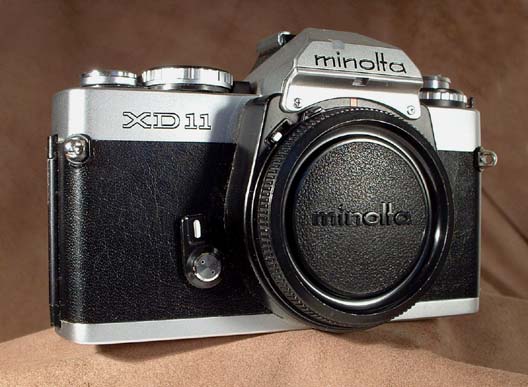
At that time, the Minolta XD-11 had just come out, creating quite a stir in the amateur photography world. It was a compact camera, about the size of the OM-1, but with exposure automation - both shutter priority and aperture priority, selectable. Of course, you could also turn off automation and use it as a match-needle (match-diode, actually, the age of electronic Wunderplastik cameras had just begun.)


So I went that route, buying an XD-11, along with an XG-7 as a second body. The XG-7 was similar, but with only aperture-priority automation plus manual operation. I also got a 24mm Rokkor lens and a zoom.

But I just didn't care for these cameras - I don't know exactly why. I think they just didn't feel as good as the OM-1's did to me. I know that technically speaking, there was nothing wrong with either camera or the lenses. Just didn't like them. I probably should have stuck with OM-1's, or maybe even an OM-1 plus an OM-2 body (the OM-2 had the option of aperture-priority automation, but in essentially the same mechanical body as the OM-1.)

After a little more than a year, I sold all the Minolta equipment for $600, a considerable loss, and I have no photos that have survived from these cameras. Most of the pictures I took during that year were with my Leicas and the Minolta CL.

Thursday, October 2, 2008

My Camera History, Part IV

Just shoot me. Kill me now...

... because I once had a Leica M3, a beautiful, clean one at that, and then sold it two years later.


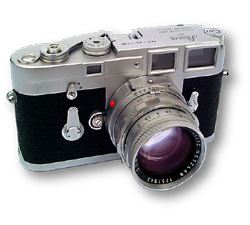
I bought the M3 DS (double-stroke) in 1978 or 1979, I can't remember exactly when - I guess it's just too painful - at my favorite little camera shop, Olden Camera, just off Herald Square. I think it was something like $350 or $380, and that included a screw-mount-to-M-mount adaptor for my 50mm collapsible Summicron. I don't think I could touch that same camera today for under a thousand dollars. Maybe I shoulda invested in Leicas instead of the stock market.

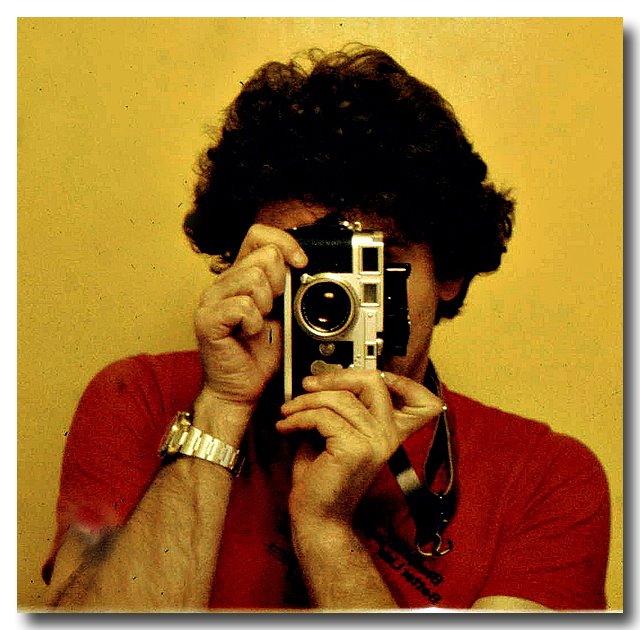
Leica M3 Self-Portrait, 1979The funny thing is, as beautiful and precise and fondle-able that camera was, I just don't remember taking a whole lot of pictures with it. I don't think I have a single photo that I can put my hands on right now that I could definitely say was taken with the M3. Don't ask.

But it gets worse. I also bought a Minolta CL in 1979. The Leica CL and Minolta CL were compact M-mount rangerfinders made by Minolta and jointly designed by Leitz and Minolta. Sort of like a Buick and an Oldsmobile. Anyway, the CL was a truly amazing design - it was even smaller than my Leica IIIc, and yet totally modern and innovative, sporting a throught-the-lens spotmeter - I think that was a first for an interchangeable-lens rangefinder.

The CL came with a very sharp 40mm f/2 Rokkor (the Leitz version were called Summicron), and it was capable of mounting other Leica lenses, either M-mount or using an adaptor, old screw-mount lenses.

Flowers on Steps, NYC (Minolta CL)I did use the CL more than the M3, but still not an awful lot compared to my earlier cameras and the Leica IIIc that I still had. At least, compared to the M3, I have one or two yellow slide boxes that are marked "CL" to show for it.

My Leica era came to an end by 1981, by which time I had sold all three cameras.

I know, I know.

Thursday, September 18, 2008

My Camera History, Part Deux

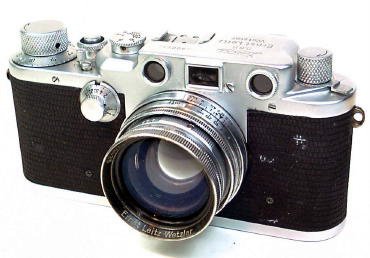
Leica IIIc
After college, I came back to Batimore, where I got my first engineering job, and where I lived for four years, until 1975.

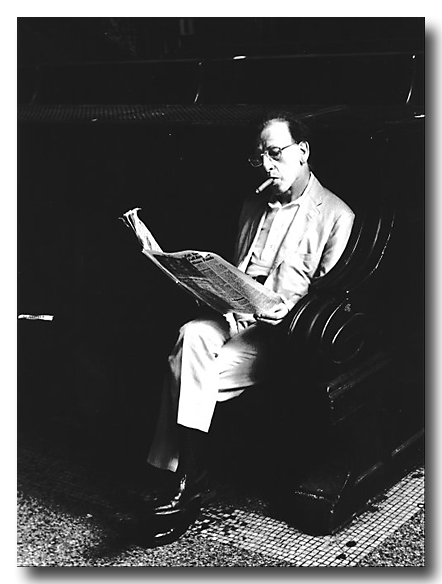
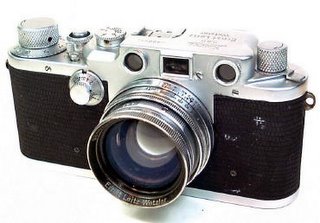
On a day trip to NYC in late summer of 1973, I bought a Leica IIIc at Olden's, along with a Canon Seranar 50mm f/1.8 lens. With 2 or 3 rolls of Plus-X in my pocket, I was suddenly a Leica photographer, in the company of Cartier-Bresson and Eisenstadt. I had parked the car in Hoboken, and after returning there, I sneaked a shot of this gentleman reading his Daily News in the Erie-Lackawanna terminal.
Man on Bench, Erie-Lackawanna Terminal, Hoboken 1973That Leica, when I bought it, was already 33 years old, but it was a thing of beauty. Compared to my Nikon, especially with its heavy and clunky Photomic T finder, it was a featherweight, and a pleasure to carry around. For some reason, compared to an SLR, the rangefinder mechanism and all the fine knurling on the various knobs gave it a feeling of watch-like precision. It may be a guy thing, but I found myself often picking it up at odd times and playing with it - not shooting pictures, just looking through the viewfinder and rangefinder (two separate windows in the old screw-mount Leicas!) and focusing it, and dry-firing it.

L'homme sur Banc, bis - Central Park, NYC 1974The Serenar was a really excellent lens, but I had really wanted a Leica lens so as to be more "authentic." A year after buying the camera, I purchased a near-mint collapsible Summicron 50mm f/2.0. I wasn't disappointed, as this turned out the be the best lens I've ever owned prior to the digital age. Besides its amazing optical performance, it was also a better physical match for the small camera than the heavy Serenar. With the Summicron collapsed, I could slip the whole package into a coat pocket.

Here's another "Man on Bench" shot, taken in New York's Central Park, September 1974, with the Summicron. I was living in pre-Urban Redevelopment downtown Baltimore at the time, which seemed pretty boring to me, so I tried to get up to New York City a few times a year for picture opportunities.
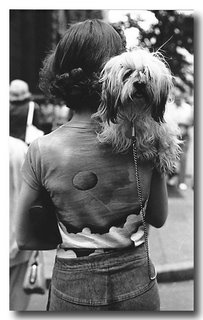
Dog on Shoulder, Madison Avenue 1974And here's one to show that I'm not afraid to get right up close to a subject and look him in the face! Check out the classic mid-'70's painted t-shirt and slightly pre-disco hairdo. This shot taken on Madison Ave in NYC, August 1974.

Like these photos here, most of what I took with the Leica was black & white. After Roger's thorough training and several years of experience developing and printing B&W during college, I wouldn't let anyone else develop or print my negatives. During those first post-college years, my darkroom was a tiny hallway between the bathroom, bedroom, and living room in my one-bedroom apartment. There was a door to each room, so I just closed the ones to the bedroom and living room, set up a table in the hallway for my enlarger and trays, stuffed towels under the closed doors to block out stray light, and I was in business.

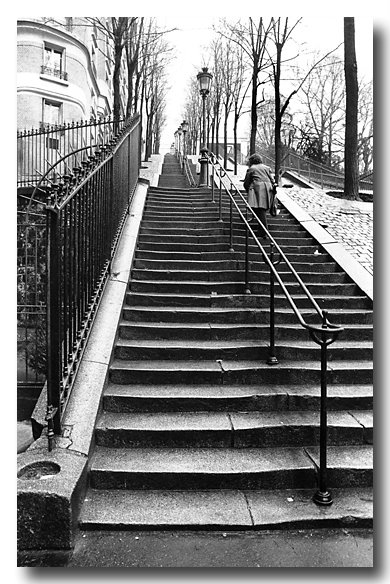
Just one more Leica photo for now, this one from the time after I had moved to Manhattan to work for GE....

Montmartre Steps - Rue Foyatier, Paris 1977Rue Foyatier, this oft-photographed stairs, climbs up the Butte Montmartre in Paris, ending near Sacre Couer basillica, the highest point in the city. It was a soggy, overcast day, and I wanted a somber, lonely look. I waited with my Leica IIIc and this solitary lady obliged me by starting the long climb upward. December 23, 1977.

Strangely, when I did a search on Google Images for "Rue Foyatier" back in early 2006, of all the Rue Foyateir photos in cyberspace, this was the first one!

But for some reason, doing the same search today yields no sign of my 1977 photo.
I guess that was my 15 Minutes of Fame.