 ... as he walks by this blue wall in Manhattan's Flower District on W. 28th Street early Saturday morning.
Join me on my next Photo Safari to Midtown Manhattan on April 2, 2011 at 1PM.
... as he walks by this blue wall in Manhattan's Flower District on W. 28th Street early Saturday morning. 

 Her smile undampened by the Friday afternoon rain, Sandy and I take shelter in the lakeside pavilion at West Drive boat landing in Central Park (taken 9/12/2008).
 Our Meetup.com gang was on the bridge during our recent trip to NYC, ready to head back to Manhattan, when we suddenly found ourselves swimming against a happy tide.
Photos from our Manhattan Meetup last Saturday.
 |  |
| Woolworth Building | Green Spiral Benches |
 |  |
| Cyber Cigar Coffee Bar - Too Many Good Things in One Place! | Brooklyn Bridge Facing East - 9AM |
 |  |
| Helen McAllister - South Street Seaport | Brooklyn-Bound Taxi |
 Our meetup.com group had a great trip to Manhattan this past Saturday. Our bus dropped us off on East Broadway, just under the Manhattan Bridge, and from there, we walked to Foley Square, then traversed the Brooklyn Bridge. After some more shooting at South Street Seaport, we subwayed up to West 86th Street and entered Central Park, walking all the way down to Grand Army Plaza.
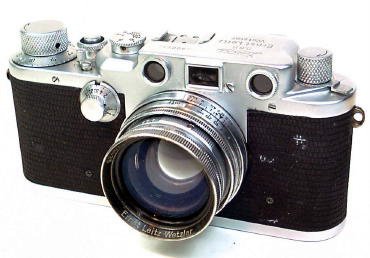
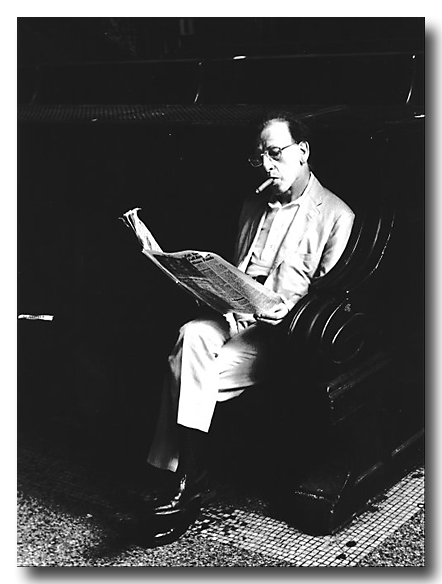 That Leica, when I bought it, was already 33 years old, but it was a thing of beauty. Compared to my Nikon, especially with its heavy and clunky Photomic T finder, it was a featherweight, and a pleasure to carry around. For some reason, compared to an SLR, the rangefinder mechanism and all the fine knurling on the various knobs gave it a feeling of watch-like precision. It may be a guy thing, but I found myself often picking it up at odd times and playing with it - not shooting pictures, just looking through the viewfinder and rangefinder (two separate windows in the old screw-mount Leicas!) and focusing it, and dry-firing it.
 The Serenar was a really excellent lens, but I had really wanted a Leica lens so as to be more "authentic." A year after buying the camera, I purchased a near-mint collapsible Summicron 50mm f/2.0. I wasn't disappointed, as this turned out the be the best lens I've ever owned prior to the digital age. Besides its amazing optical performance, it was also a better physical match for the small camera than the heavy Serenar. With the Summicron collapsed, I could slip the whole package into a coat pocket.
 And here's one to show that I'm not afraid to get right up close to a subject and look him in the face! Check out the classic mid-'70's painted t-shirt and slightly pre-disco hairdo. This shot taken on Madison Ave in NYC, August 1974.
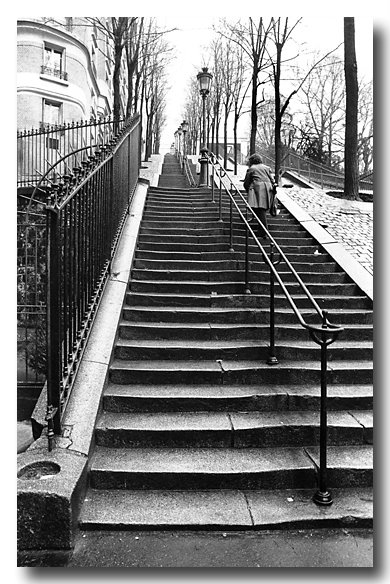 Rue Foyatier, this oft-photographed stairs, climbs up the Butte Montmartre in Paris, ending near Sacre Couer basillica, the highest point in the city. It was a soggy, overcast day, and I wanted a somber, lonely look. I waited with my Leica IIIc and this solitary lady obliged me by starting the long climb upward. December 23, 1977.

But this one song, Imagine, bugs me. And it bugs me that many people think of this song when they think of Lennon, despite the fact that he wrote so many other songs, great songs.
It's not the music, which is pretty enough, but the words that bother me. The ideas in those words.
No religion. No countries. Nothing to live or die for. Yeah, we've seen that before. It was called the Soviet Union. We see it now in "Old Europe." And we continue to see it in the politically and socially dysfunctional petty tyrannies of the Middle East.
In an insightful Wall Street Journal opinion piece last June, Bret Stephens expresses former Prisoner of Conscience Natan Sharansky's take on the Imagine concept:
| Mr. Sharansky's argument is that man's quest for identity – for the human and communal particulars that set him apart from others – cannot be separated from his quest for freedom – the universal set of values to which he and everyone else lay an equal claim. He argues that a freedom that "does not include the freedom to be significantly different" is no freedom at all. And he believes that while a politics that expresses itself purely through identity is bound to be tyrannical, a democracy that ignores its own identity – or attempts to suppress the various identities within it – betrays its deepest principles and puts its long-term survival at risk. |
John Lennon and Yoko Ono created conceptual country, Nutopia, a notional nation that was founded on the principles of the song, Imagine. That was there solution.
But as John himself wrote, "You say you got a real solution, well, we'd all love to see the plan."
Ok, my Grinch-like detour to politics and philosophy is over, now back to photography. I took the photo above this past weekend in the section of New York's Central Park called Strawberry Fields, a tear-shaped, 2.5 acre plot dedicated to John Lennon.
The handsome mosaic is a reproduction (except for the "Imagine" inscription) of one uncovered in Pompeii, a gift of the city of Naples, Italy. A fellow has taken it on himself to arrange flowers in and around the mosaic every day since 1993.
All this combined with people gathered around the mosaic or sitting on the benches that encircle it make for a good photo opportunity.
 Why is it that when I take a picture of a tall building, it often looks distorted? Gee, those walls sure looked perpendicular to the ground and parallel to each other when I was standing there! But in the image I come home with, the walls are at all sorts of angles, and the building looks like it's falling over backwards.
 Start with the Image menu, and select Transformation, and then Skew. You'll see a dialog like this one. Just click the OK button.
 This will bring up the New Layer dialog. While it's good practice to name layers with a meaningful name, we'll be throwing this layer away soon anyway, so just click the OK button and continue to the next step. (Layers are a subject for a whole other post, or really several posts.)
 At this point, you'll see a thin box around the entire image. The box also has tiny circles at each of the corners and at the midpoint along each side. You can grab the box at any one of the circles (think of them as "handles") and tug or push your image.
 Here is the final photo, after I gave it my 30-second Photoshop 80-20 Rule treatment to color-correct and contrast-sharpen the image.
 Sandy and I spent a great two days in New York City this weekend, seeing Mama Mia! on Broadway and doing some sightseeing.


